The European Parliament:
a closer look

Scroll down

From 6 to 9 June 2024, in the world’s largest transnational elections, EU citizens will vote to elect their European Parliament representatives. What are the current trends and what can we expect for the 10th term?

At first glance,
the Political Balance

Presently, for the 2019-2024 legislature, there are seven political groups serving in the European Parliament. Below, you will find the current political balance, in terms of each political group’s share of the total 705 seats
The Left
5.5%
39 seats
S&D
20.6%
145 seats
The Greens/EFA
10.4%
73 seats
Renew
14.3%
101 seats
EPP
25.1%
177 seats
ECR
9.1%
64 seats
ID
9.2%
65 seats
NI
5.8%
41 seats
European Parliament,
1979-2019

With an idea of the current political balance in the European Parliament, take a look back at the evolution and history of each political group. The data, in percentages of total seats, refer to the constituent session (in July) at the beginning of each parliamentary term.

Strengths of the political groups in each parliamentary term
1979 1984 1989 1994 1999 2004 2009 2014 2019 10 10 0 20 20 30 30 40 40 50 50 60 60 T he L e f t S&D G r eens/E F A R enew E u r ope EPP ECR ID NI O ther 6.7% 28.8% 7.7% 8.0% 37.2% 7.7% 4.9% 34.9% 4.1% 7.8% 27.5% 4.8% 16.2% 5.4% 34.7% 5.8% 9.5% 23.4% 12.4% 9.4% 30% 7.1% 25.3% 11.5% 15% 10.7% 27.3% 9.8% 26.3% 15.4% 8.1% 5.5% 20.6% 9.9% 14.4% 24.3% 8.3% 9.8% 7.2% 6.9% 25.4% 6.7% 8.9% 29.4% 9.3% 6.4% 6.9% 4.8% 25% 7.5% 11.4% 36% 7.3% 4.3% 5.6% 27.3% 5.7% 12.0% 36.6% 4.0% 5.1%
Hover around for more information

About the current parliamentary term

In 2019, how many of these MEPs were elected for the first time?

Some MEPs heave a lengthy career within the European Parliament, while some others are elected for the very first time.

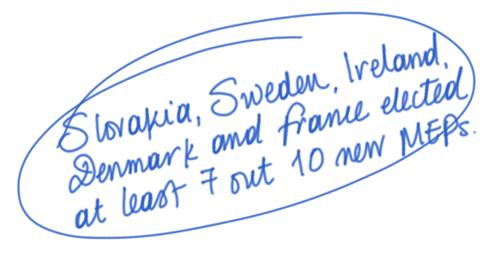
In 2019, 59.6% MEPs were elected for the first time.

Longstanding majority groups EPP and S&D saw a relatively small amount of newly elected MEPs, while Identity and Democracy (ID) had the highest percentage of new MEPs, with a 79.2 % share of newly-elected MEPs.

59.6% Newly-elected MEPs

How old are the MEPs?

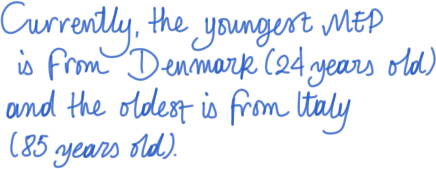
The average age of MEPs is currently at 52 years with the majority of MEPs aged between 41 and 60 years old. See below, the age distribution of the presently serving 705 MEPs.

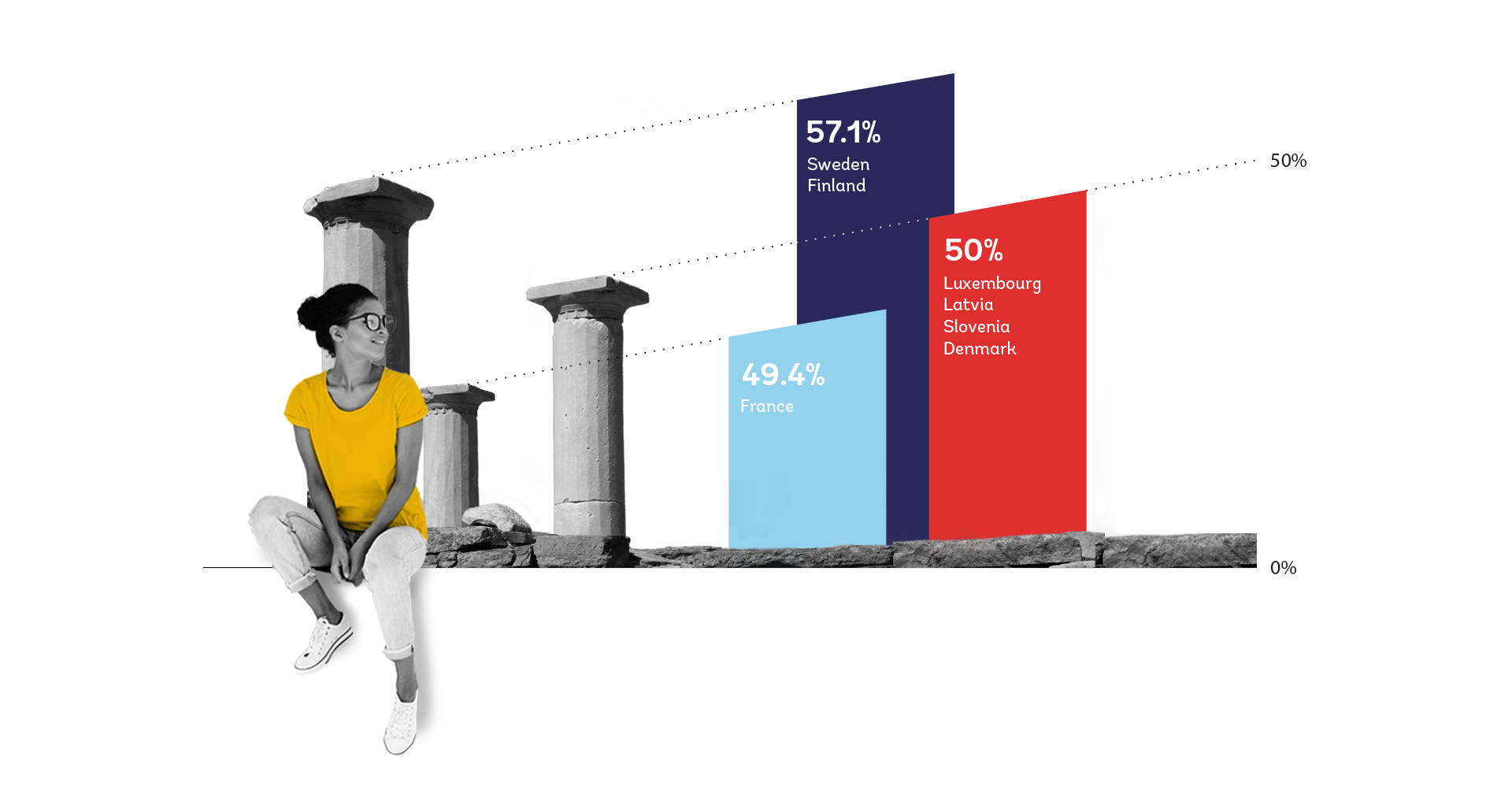
50% Sweden Finland 57.1% Luxembourg Latvia Slovenia Denmark 50% France 49.4% 0%

In-house gender balance:
How many of the MEPs are women?

On average, close to 4 out of 10 MEPs are women. Only a few countries have complete or nearly equal gender balance in their representation in the parliament. Sweden and Finland are the current leaders with close to 6 out of 10 MEPs being women, followed by Luxembourg, Latvia, Slovenia, and Denmark having achieved parity. On the other hand, Romania is second to last, with a 15.2% of their MEPs women while Cyprus has no women elected in the European Parliament.

How do people elect the MEPs?

The European elections are held every 5 years. Although electoral systems vary between Member States, certain common provisions such as proportional representation have to be respected. Proportional representation means that the number of seats any one national party obtains in the European Parliament is proportional to the number of votes the party received in the respective national EU elections. Despite these common provisions, the exact electoral system is up to the individual member states.

Preferential Voting:

Candidates are ranked in order of preference. This system ensures that the candidate with the broadest support wins.

Closed List:

Political parties present a pre-determined list of candidates. Voters choose a party, and seats are allocated to candidates based on the proportion of votes each party receives. This system focuses on party representation rather than individual candidate selection.

Single Transferable Vote:

Voters rank candidates in order of preference, similar to preferential voting. This system is used in multi-member constituencies, and candidates need a certain quota of votes to be elected. Surplus votes from elected candidates or votes from eliminated candidates are transferred to the remaining candidates, ensuring a more proportional outcome.

Multiple Constituencies:

Countries or regions are divided into smaller areas called constituencies. Each constituency elects its own representative(s) through various voting methods like first-past-the-post or proportional representation. This system allows for local representation and tailors the political landscape to specific geographic regions.

European Parliament voting system
Preferential voting
Closed lists
STV (Single Transferable vote)
Multiple constituencies
Countries of Europe A blank Map of Europe. Every country has an id which is its ISO-3166-1-ALPHA2 code in lower case. Members of the EU have a class="eu", countries in europe (which I found turkey to be but russia not) have a class="europe". Certain countries are further subdivided the United Kingdom has gb-gbn for Great Britain and gb-nir for Northern Ireland. Russia is divided into ru-kgd for the Kaliningrad Oblast and ru-main for the Main body of Russia. There is the additional grouping #xb for the "British Islands" (the UK with its Crown Dependencies - Jersey, Guernsey and the Isle of Man) and the Kingdom of Denmark (Denmark, Faroe Islands, Greenland) Contributors. Original Image: (http://commons.wikimedia.org/wiki/Image:Europe_countries.svg) Júlio Reis (http://commons.wikimedia.org/wiki/User:Tintazul). Recolouring and tagging with country codes: Marian "maix" Sigler (http://commons.wikimedia.org/wiki/User:Maix) Improved geographical features: http://commons.wikimedia.org/wiki/User:W!B: Updated to reflect dissolution of Serbia & Montenegro: http://commons.wikimedia.org/wiki/User:Zirland Updated to include British Crown Dependencies as seperate entities and regroup them as "British Islands", with some simplifications to the XML and CSS: James Hardy (http://commons.wikimedia.org/wiki/User:MrWeeble) Validated (http://commons.wikimedia.org/wiki/User:CarolSpears) Changed the country code of Serbia to RS per http://en.wikipedia.org/wiki/Serbian_country_codes and the file http://www.iso.org/iso/iso3166_en_code_lists.txt (http://commons.wikimedia.org/wiki/User:TimothyBourke) Uploaded on behalf of User:Checkit, direct complaints to him plox: 'Moved countries out of the "outlines" group, removed "outlines" style class, remove separate style information for Russia' (http://commons.wikimedia.org/wiki/User:Collard) Updated various coastlines and boarders and added various islands not previously shown (details follow). Added Kosovo, Northern Cyprus, Crimea, Abkhazia, South Ossetia, Transnistria and Nagorno-Karabakh as disputed territories. Moved major lakes to their own object and added more. List of updated boarders/coastlines: British Isles (+ added Isle of Wight, Skye, various smaller islands), the Netherlands, Germany, Austria, Hungary, Czech Republic, Denmark, Sweden, Finland, Poland, Kaliningrad Oblast of the Russian Federation (and minor tweaks to Lithuania), Estonia, Ukraine, Moldova (minor), Romania, Bulgaria, Turkey, Greece, F.Y.R. Macedonia, Serbia, Bosnia and Herzegovina, Montenegro, Albania, Croatia, Italy (mainland and Sicily), Malta (http://commons.wikimedia.org/wiki/User:Alphathon). Added Bornholm (http://commons.wikimedia.org/wiki/User:Heb) Released under CreativeCommons Attribution ShareAlike (http://creativecommons.org/licenses/by-sa/2.5/). image/svg+xml Countries of Europe

The Turnout paradox

The 1979 elections had the highest turnout percentage in the history of the European Parliament, 61.8%. Since then, the turnout rate has dropped steadily, although, in reality, the number of voters has increased, in parallel with the increasing number of Member States.

The most recent election in 2019 saw turnout rise from 42.6 to 50.6 per cent (plus 8.0 percentage points), making it the first term since 1994 in which about half of those eligible actually cast their ballot.

European elections turnout between 1979 and 2019
Click on the countries to compare

By looking at both the current parliamentary term (July 2019 to June 2024) and the eight previous five-year terms since direct elections were introduced in June 1979, this platform has provided a few facts and figures about the European Parliament. To get further information and learn more about the work of the Parliament, its structure and the legislative activity, find the full publication from March 2022.

Read the full publication here.